7 Ways AI Is Transforming Contact Centers and Improving Customer Support
- Home
- SupportMinions Blog
- 7 Ways AI Is Transforming Contact Centers and Improving Customer Support

A customer calls to check an appointment. Another needs help resolving a billing dispute. A third has been transferred between departments and is frustrated at having to explain the same problem again.
These may all be customer service interactions, but they do not require the same level of human involvement.
Some can be handled through self-service or an AI voicebot. Others need an agent who can investigate, exercise judgement and understand the customer's circumstances. And in many cases, AI can help an agent resolve the issue more effectively.
This is where the conversation about artificial intelligence and contact center jobs needs to move forward.
Rather than asking only whether AI will replace customer service agents, organisations should ask a more useful question: How should work be redesigned when AI can handle more tasks, but people remain essential to delivering good customer experiences?
AI is Changing How Contact Center Agents Work
AI Adoption Is Moving Quickly, but Workforce Transformation Is More Complex
Pressure to adopt AI is growing across customer service operations.
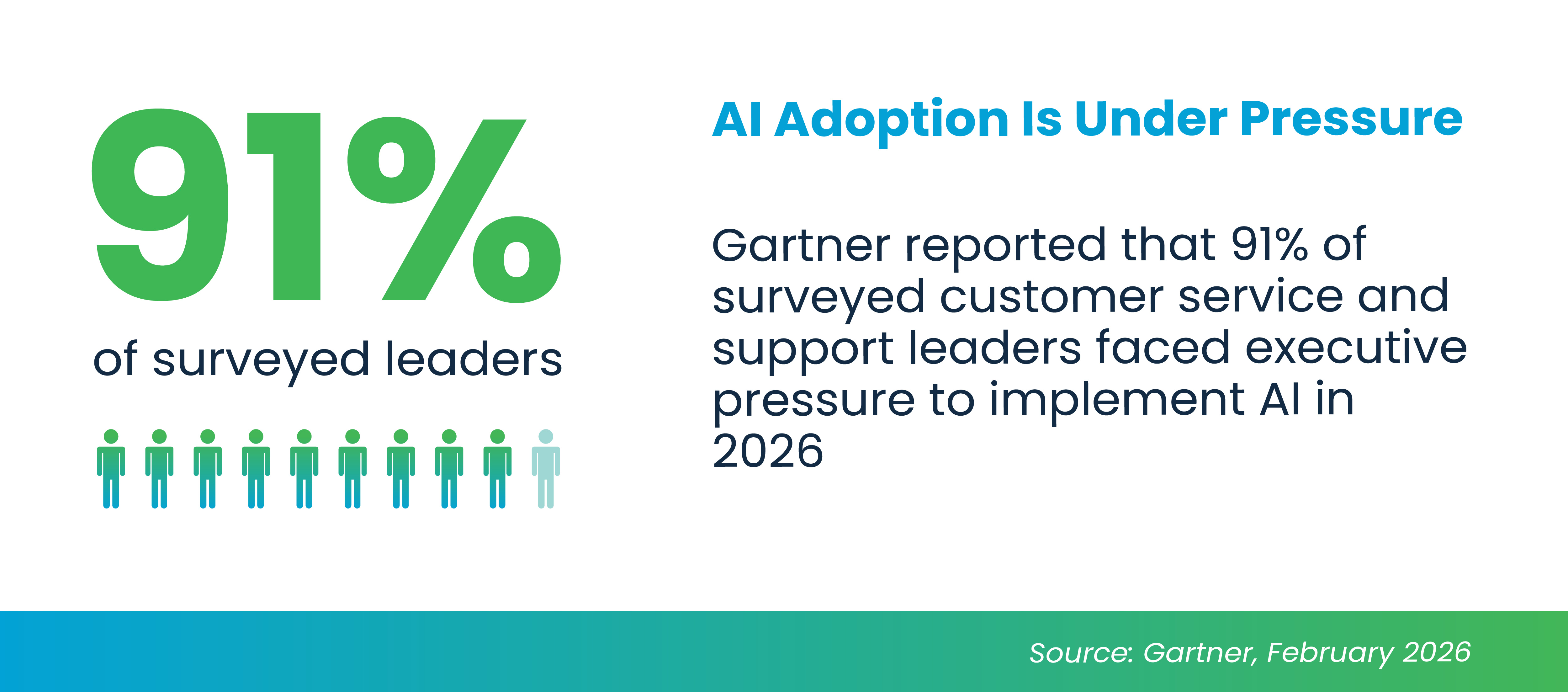
In a February 2026 survey, Gartner reported that 91% of surveyed customer service and support leaders faced executive pressure to implement AI. Nearly 80% of organisations planned to transition at least some agents into new roles, while 84% intended to add new skills to the agent role. Source: Gartner, February 2026
These findings suggest that the discussion is becoming broader than automation alone. Organisations are also considering how jobs, responsibilities and skills need to evolve.
However, introducing AI does not automatically improve customer service. If a company automates the wrong interactions, provides agents with poorly integrated tools or makes it difficult for customers to reach a person, the result may be more frustration rather than better service.
The opportunity lies in deciding which tasks AI should handle, where it should assist employees and when human judgement should take priority.
1. AI Can Handle More Routine Conversations, Including by Phone
Many contact centers receive a high volume of repetitive enquiries: appointment confirmations, operating hours, order updates, payment reminders and frequently asked questions.
These interactions can consume significant agent time, even when they follow a predictable process.
AI voicebots provide another way to manage such work. Instead of requiring a human agent to answer every call, an AI voicebot can respond to common questions, collect information, check connected systems and complete configured tasks.
For example, a healthcare provider could use an AI voicebot to help patients book or confirm appointments. A service company could automate routine reminders. Automotive sales teams can use outbound voice automation to follow up with new leads and invite potential customers to weekend dealership events.
SupportMinions AI Voice is designed to support inbound and outbound voice workflows, with capabilities such as appointment booking, lead qualification, customer support and follow-up calls. It can also connect with business systems and transfer conversations to a human when required.
Explore SupportMinions AI Voice
The important distinction is that automating a conversation does not mean automating every possible outcome. A voicebot may handle a straightforward request, but a complaint involving several departments, an unusual account issue or a sensitive customer situation may require human intervention.
The objective is to reduce unnecessary work while preserving access to meaningful assistance.
2. Human Agents Can Spend More Time Solving Problems
When AI takes on appropriate routine tasks, the role of a human agent can shift towards work those benefits from judgement, empathy and problem-solving.
Consider two examples.
A customer asking for a business's opening hours may receive an immediate answer through an automated channel. A customer disputing a charge, however, may need an agent to investigate the transaction, understand the circumstances and explain the available options.
In the second situation, success depends on more than producing an answer quickly. The agent needs the right information, authority to take action and the ability to communicate clearly.
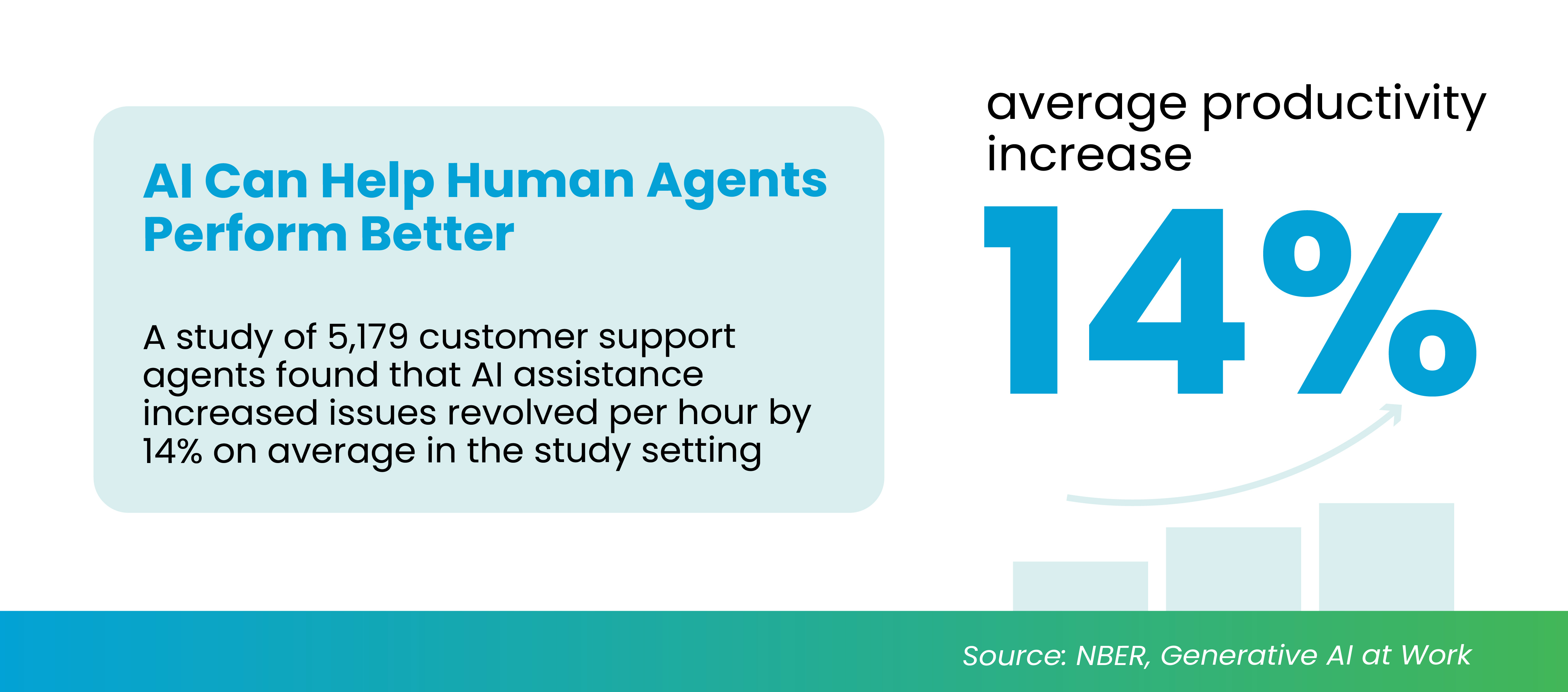
Research offers some evidence that AI assistance can also improve how human agents perform. A study of 5,179 customer support agents, published in the Quarterly Journal of Economics, found that access to a generative AI assistant increased productivity by 14% on average, measured by issues resolved per hour. The benefits were larger for less experienced and lower-skilled agents in that particular setting.
Source: NBER, Generative AI at Work
This is encouraging, but it should not be interpreted as a guaranteed result for every contact center. Outcomes depend on the tasks involved, the quality of AI assistance, the knowledge available to agents and how well the technology fits into daily operations.
For managers, the practical lesson is to evaluate AI by whether it helps employees resolve customer issues more effectively, not simply by how many tasks it can automate.
3. AI Can Change Quality Monitoring from Sampling to Continuous Improvement
Quality assurance is another area where contact center work can evolve.
Traditional quality monitoring often involves supervisors reviewing a sample of calls against a defined scorecard. Sampling remains useful, but it can make it difficult to identify recurring issues across a large volume of interactions.
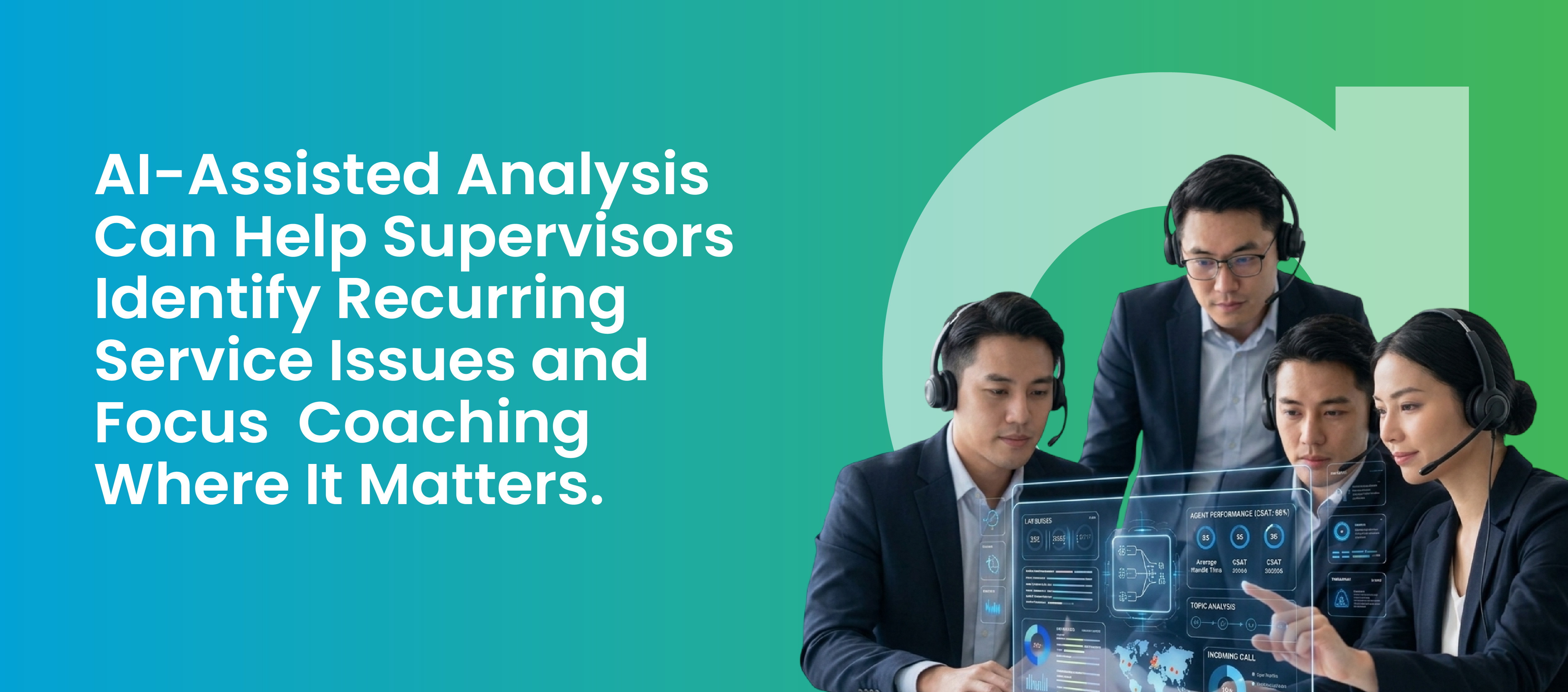
AI-assisted transcription, summarisation and interaction analysis can help organisations review more conversations, identify potential service gaps and surface interactions for further investigation.
For example, a contact center may discover that customers repeatedly ask for clarification about the same policy. Another may identify that agents struggle to explain a particular process. A third may find that a recurring issue originates from an unclear self-service journey rather than an agent's performance.
These insights can inform coaching, process improvement, knowledge updates and customer journey redesign.
AI-generated scores and summaries still need appropriate oversight. Transcription errors, missing context and inaccurate interpretations can affect the results. Organisations should validate their evaluation criteria, review exceptions and retain human judgement for important decisions.
The wider opportunity is to use quality monitoring not only to assess individual agents, but also to understand where the service operation itself needs improvement.
SupportMinions Cura, AI-powered Quality Monitoring that evaluates every customer interaction. SupportMinions Cura helps organisations evaluate customer interactions against configurable quality criteria, enabling teams to identify service gaps, review performance trends, and focus coaching efforts where they are needed most.
4. AI Voicebots and Human Agents Should Work as Part of One Service Journey
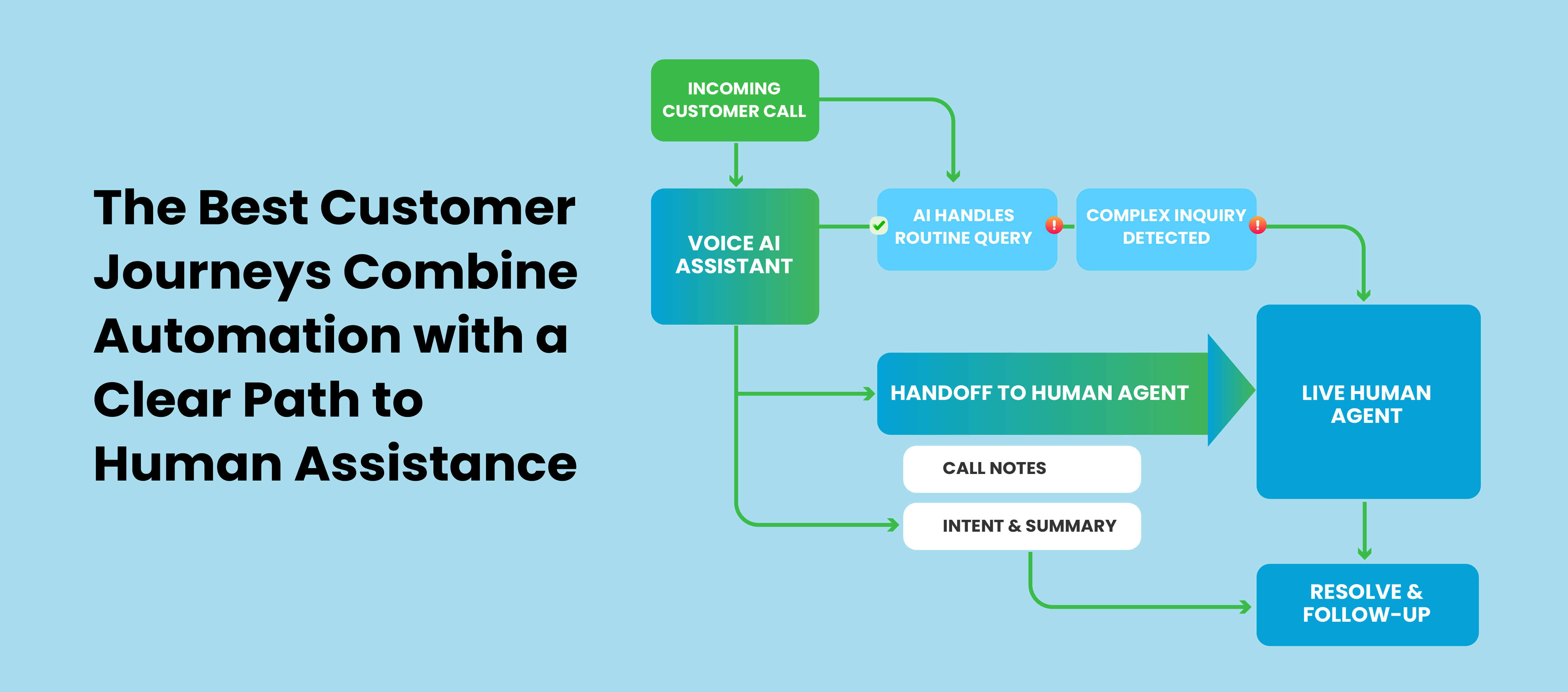
Customers do not think in terms of separate AI, telephony, chat and ticketing systems. They simply want their issue resolved.
This is why organisations should avoid treating each automation project as a standalone initiative.
Imagine a customer calls to ask about an order. An AI voicebot retrieves the relevant information from a connected system and provides an update. The customer then explains that the delivery delay has caused a problem. The voicebot transfers the call to a human agent, who needs enough context to continue the conversation without making the customer repeat everything.
The value comes not just from answering the initial question, but from managing the transition between automated assistance and human support.
This requires clear escalation rules, appropriate system integration and access to relevant customer information. It also requires organisations to decide what information should be passed between systems and how the receiving agent can act on it.
An omnichannel contact center can help connect voice, chat, ticketing and other customer engagement workflows. SupportMinions Omni brings together capabilities including SupportMinions Voice, SupportMinions Chat, SupportMinions Desk and SupportMinions Social to support connected customer interactions.
The goal is not to put AI everywhere. It is to make the customer journey more coherent, regardless of which channel or team handles the interaction.
5. The Agent Role Will Require New Skills
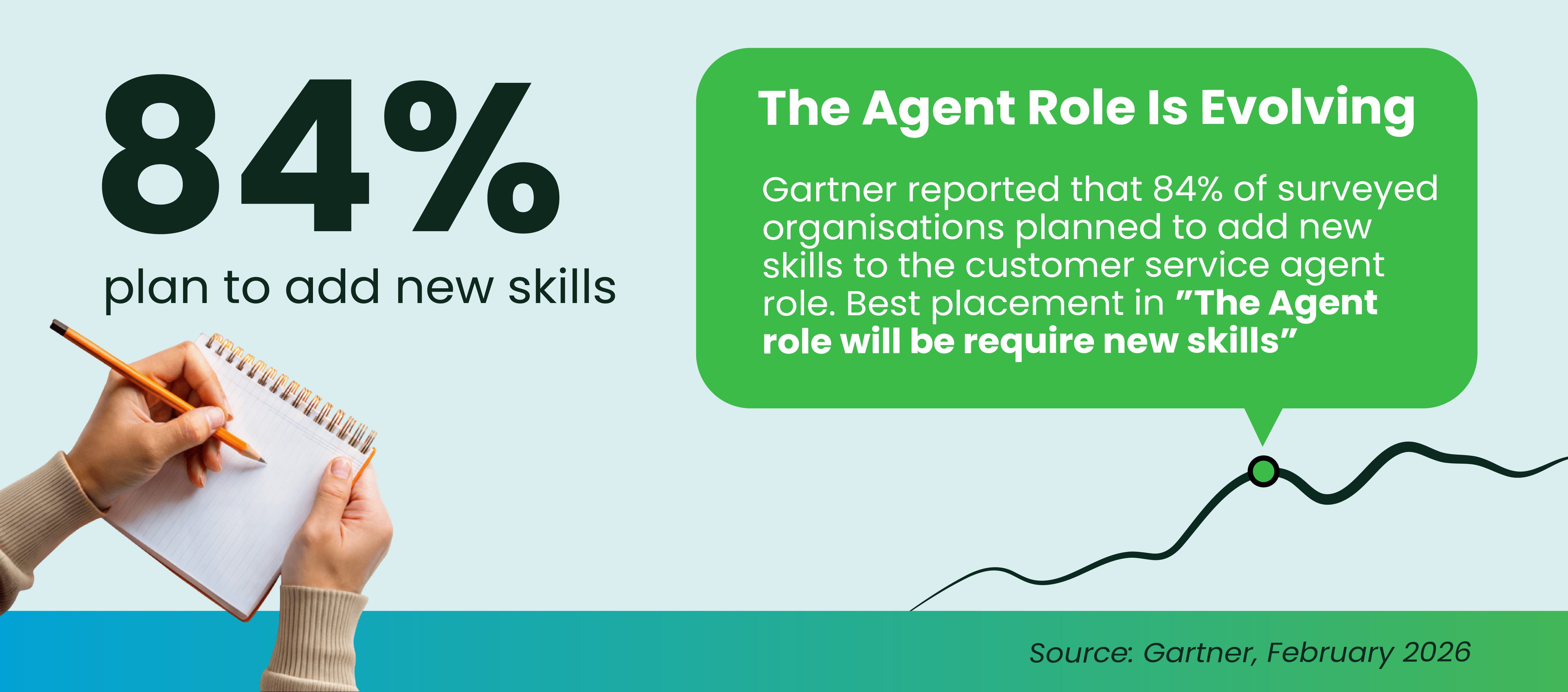
As AI becomes more involved in routine tasks and information retrieval, organisations should reconsider how they recruit, train and develop contact center employees.
The agent of the future may need less time to search for basic information, but more ability to interpret information, recognise exceptions and decide what to do next.
Important skills include:
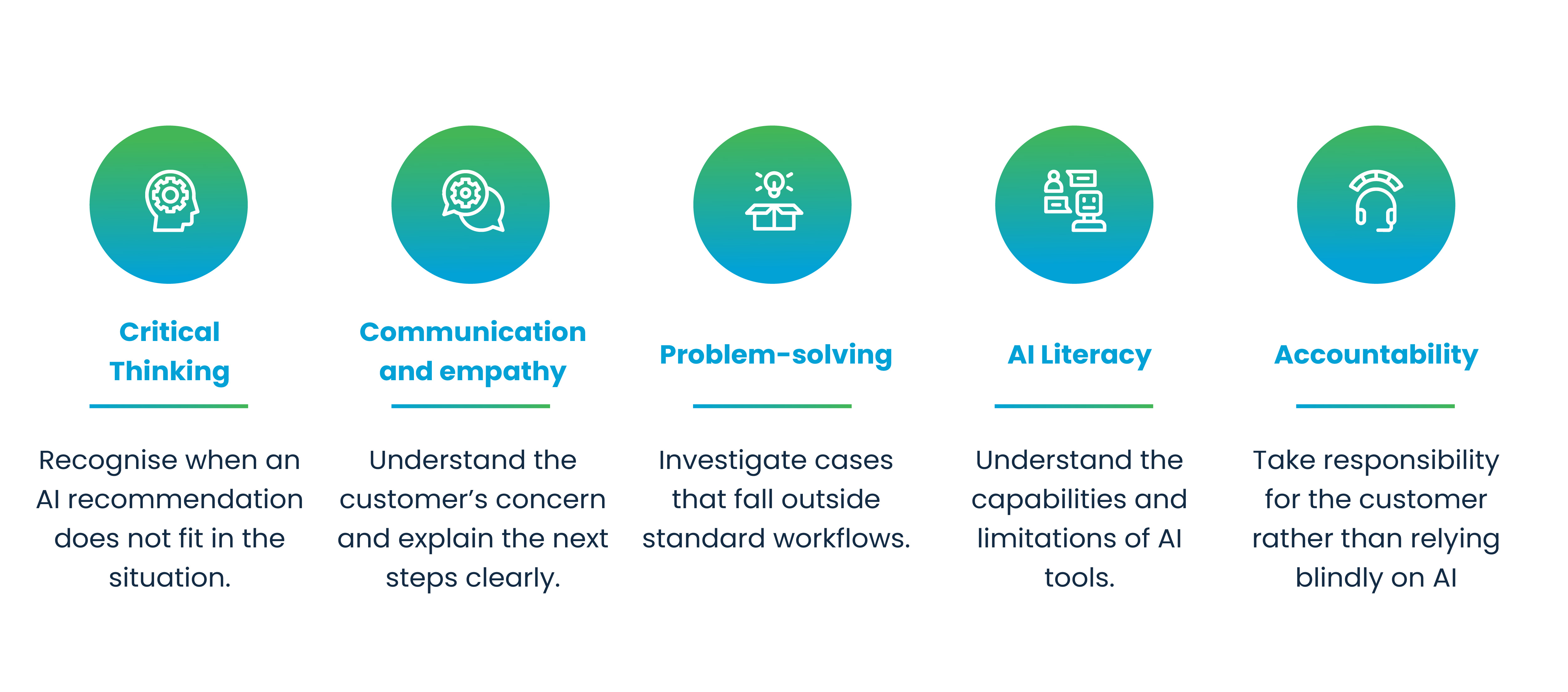
Supervisors will also need to develop their skills. Alongside managing service levels and agent performance, they may increasingly be responsible for reviewing AI-assisted workflows, identifying knowledge gaps and helping teams adapt to new ways of working.
This transition requires investment in training and change management. Simply deploying a new tool and expecting employees to adjust on their own is unlikely to deliver the best results.
6. What This Means for Malaysian Contact Centers
For Malaysian organisations, AI adoption needs to reflect the realities of their customers and operations.
Language preferences, service hours, existing telephony infrastructure, legacy business systems and customer expectations can all affect how an AI solution performs. In multilingual environments, organisations should also assess whether the chosen voice and speech technologies can handle the languages and speaking patterns of their intended customers.
AI voice automation may be useful for selected inbound enquiries, appointment reminders, payment follow-ups and outbound campaigns. AI chatbots may be appropriate for routine digital enquiries, while human agents remain essential for complex cases and situations requiring discretion.
These are not decisions that should be made purely on the basis of what a technology can demonstrate. Organisations need to consider customer impact, operational readiness, integration requirements, data protection and the process for handling failures or escalations.
The Contact Centre Association of Malaysia has appointed Ipsos as its research partner for the Malaysia Contact Centre: State of Business 2026/30 Research Study, which is intended to examine areas including workforce and future skills, AI and emerging technology adoption, and the industry's competitiveness.
Source: Contact Centre Association of Malaysia
The study is a useful indication of the importance of these topics to the local industry. Its announcement should not, however, be mistaken for completed research findings.
For businesses beginning their AI journey, a sensible approach is to start with one well-defined customer interaction, establish the expected outcome and test the workflow before expanding. This makes it easier to identify operational gaps and build employee confidence before wider deployment.
7. The Biggest Risk Is Automating Without Rethinking the Customer Experience
AI can make a task faster without making the overall experience better.
For example, a company may automate its first-line phone enquiries but leave customers with no clear route to a person when their situation falls outside the automated workflow. Another may introduce an agent-assistance tool but require employees to switch between multiple disconnected applications to use it.
In both cases, the technology may work as intended while the customer or employee experience remains poor.
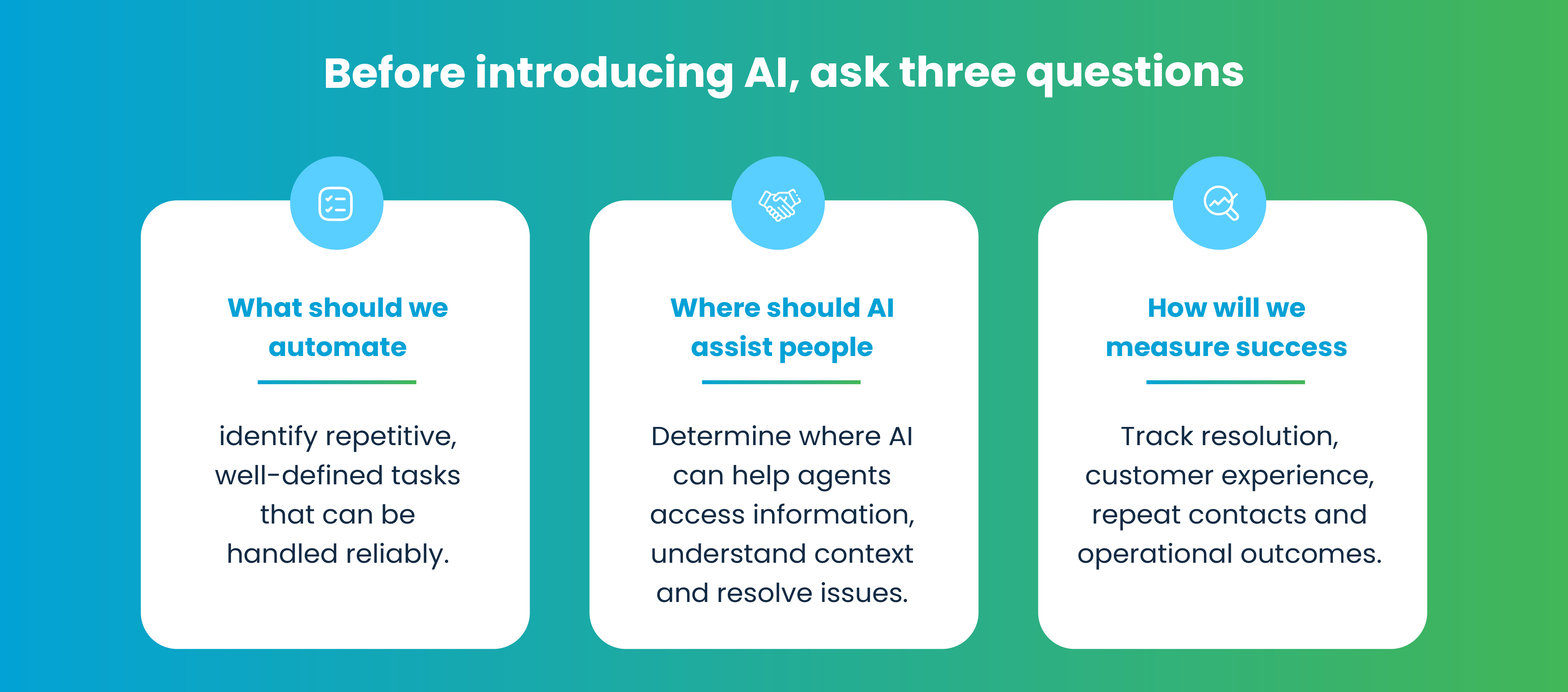
The right measures will vary by use case. A reminder-calling workflow may be evaluated differently from a complex customer support journey. What matters is that the organisation defines success before deployment and reviews the results after launch.
Technology should support a better service process, not become a substitute for designing one.
The Future Is About Better Use of Human and AI Capabilities
AI is changing contact center jobs, but the most useful way to understand that change is to look beyond headcount.
Routine tasks can increasingly be automated. AI can help agents find information and improve their work. Quality monitoring can uncover patterns that were difficult to see through manual sampling alone. New responsibilities are emerging around knowledge, AI oversight and service improvement.
But none of these capabilities removes the need to understand customers, make sound decisions or take responsibility when something goes wrong.
In our experience, the technology question should always be connected to an operational question: what problem are we trying to solve, and how will the customer and the employee benefit?
For SupportMinions Global, that is the more important conversation. Solutions such as SupportMinions Omni, SupportMinions ACE, SupportMinions AI Voicebot, and SupportMinions Cura (AI Quality Monitoring) can support different parts of the customer journey, but the value comes from how they are implemented, integrated and managed within the organisation.
Frequently Asked Questions
Will AI replace contact center agents?
AI can automate some routine interactions and tasks, but complex complaints, sensitive situations and cases requiring judgement may still need human agents. The impact on jobs will vary by organisation, use case and implementation approach.
How is AI changing the role of a contact center agent?
Agents may spend less time on repetitive enquiries and manual information gathering, and more time resolving complex issues, interpreting AI-assisted information and supporting customers who need human help. Their responsibilities and required skills will depend on how the organisation redesigns its service processes.
What is an AI voicebot in a contact center?
An AI voicebot uses voice-based AI to interact with callers. Depending on its configuration and system connections, it can answer common questions, collect information, book appointments, conduct follow-up calls and transfer customers to a human agent when needed.
How can AI help improve contact center quality assurance?
AI-assisted transcription, summarisation and conversation analysis can help teams review interactions, identify patterns and highlight areas for coaching or process improvement. Human oversight remains important because AI-generated assessments can contain errors or miss context.
What should Malaysian businesses consider before adopting AI in customer service?
They should evaluate customer needs, language requirements, suitable use cases, system integration, data protection, escalation processes, employee training and measurable business outcomes. Starting with a focused pilot can help an organisation validate the approach before scaling.
How does an omnichannel contact center support AI adoption?
An omnichannel contact center can help connect interactions across voice, chat, ticketing and social channels. When systems share relevant information and support appropriate handovers, customers can receive more consistent service without being forced to repeat their issue at every step.

Copyright © 2026 SupportMinions Global Sdn Bhd. All Rights